Author: Miriam Waititu-Buff | Editor: Laure Pauly, Anja Leist
Once upon a time, training your brain meant doing a crossword in the newspaper while drinking coffee strong enough to wake the dead. These days, it means downloading an app that promises to turn you into a memory ninja or a focus monk. Brain games are everywhere, but do they work, or are they just digital fidget spinners for the mind?
What Are Brain Games?
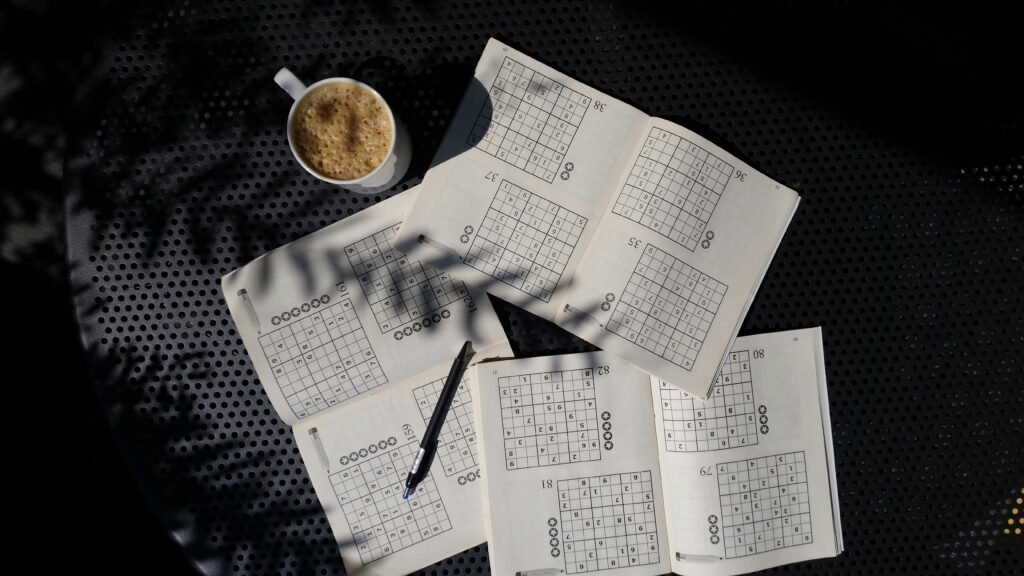
Brain games is a term for puzzles and tasks designed to challenge cognitive skills like memory, attention, processing speed, and problem-solving. Think about Sudoku, crosswords, chess, memory-matching games, and modern app-based programs
The basic idea is seductively simple: If exercise strengthens muscles, then mental exercise must strengthen the brain. Sounds reasonable, right? After all, your brain does weigh about 1.4 kilograms and consumes an alarming amount of energy. Surely a few daily puzzles will whip it into Olympic shape. Well, yes and no. Science’s favorite answer ;-).
The Promise: Sharper Mind, Better Life, Eternal Glory
Brain game marketing often implies that a few minutes a day will improve your intelligence, prevent cognitive decline, and possibly make you unbeatable at trivia night.
Researchers generally agree on one thing: practicing a task makes you better at THAT task. If you play a memory game where you remember sequences of colored squares, congratulations you will get very good at remembering sequences of colored squares.
The million-dollar question is whether this improvement transfers to everyday life. Does crushing it at a brain game mean you’ll remember names better, focus longer at work or suddenly understand your tax return?
The Science: Transfer Is Tricky
Psychologists distinguish between near transfer and far transfer:
- Near transfer: Skills improve in very similar tasks.
- Far transfer: Skills improve in different, real-world tasks (the holy grail).
Most evidence is strong for near transfer and weak (or nonexistent) for far transfer when it comes to brain games (1). In plain English: getting better at a game mostly helps you getting better just at that particular game. A large study found no evidence that these games improved general cognitive abilities (2). In other words, brain games are not a magical shield against aging.
Wait, … So Are Brain Games Useless?
Not so fast. This is where nuance sneaks in like a cat knocking things off a shelf. Brain games can be useful in specific contexts:
- Skill practice: Want faster mental math? Practice mental math.
- Want better visual attention? Games that train that skill may help, for similar tasks.
- Motivation and routine: Brain games can encourage people to engage regularly with mentally challenging material and can increase sustained focus through practice. Consistency matters more than novelty.
- Rehabilitation and clinical use: In targeted settings, such as stroke recovery or attention training for specific conditions—, carefully designed cognitive training can be beneficial when guided by professionals (3).
- Fun: Enjoyment is not a trivial outcome. If you like puzzles, that pleasure alone has value. You are allowed to have fun without optimizing your hippocampus.
The Brain Is Not a Muscle
One common misconception is that the brain works like your bicep: train it hard enough, and everything gets stronger. The brain is more like a team of highly specialized interns. Training one intern does not automatically make the others better at their jobs.
Cognitive abilities are surprisingly specific. Improving working memory does not reliably improve reasoning. Improving attention in one format does not magically boost attention everywhere else (1).
So What Brain Training Does Help Brain Health?
Here’s the plot twist: the most effective ways to support cognitive health are also the least flashy. Research consistently shows benefits from Physical exercise (especially aerobic activity), adequate sleep, social interaction, learning new and meaningful skills (languages, music, crafts), and managing stress. These activities engage multiple brain systems at once and connect to real life. It is not only about learning new things, it’s also about HOW to learn new things. Here are some useful tips for you.
How to Use Brain Games Without Fooling Yourself
If you enjoy brain games, great! Just use them wisely:
- Play because you enjoy them, not because you expect to become a genius.
- Mix them up with real-world challenges.
- Don’t replace physical activity or social time with yet another round of digital whack-a-mole.
- Be skeptical of bold claims that sound like they were written by a wizard.
Think of brain games like puzzles in a waiting room: pleasant, mildly stimulating, and unlikely to transform your destiny.
For better readability of the text, the assistance of Microsoft Copilot, an AI language model based on the GPT-4 architecture, secured with UL enterprise data protection, has been used.
- Nguyen, L., Murphy, K., & Andrews, G. (2022). A game a day keeps cognitive decline away? A systematic review and meta-analysis of commercially-available brain training programs in healthy and cognitively impaired older adults. Neuropsychology Review, 32(3), 601-630.
- Ballard, C. G., Corbett, A., Clack, H., & Owen, A. (2010). P4‐113: Can Brain Training Games Improve Cognition in People Over 60?. Alzheimer’s & Dementia, 6, e55-e56.
- Cicerone, K. D., Goldin, Y., Ganci, K., Rosenbaum, A., Wethe, J. V., Langenbahn, D. M., … & Harley, J. P. (2019). Evidence-based cognitive rehabilitation: systematic review of the literature from 2009 through 2014. Archives of physical medicine and rehabilitation, 100(8), 1515-1533.