
Author: Laure Pauly, Anja Leist
We present the science here, and encourage you to look out for yellow boxes for actionable tips for your brainpower.
A large part of brain health is in our hands
Many people believe that “bad genes” determine everything, but research shows that lifestyle plays a much bigger role.1 One good example here is the recent scientific result showing that nearly half of dementia cases and more than half of strokes could potentially be prevented by addressing modifiable risk factors, the everyday habits we can influence.2,3 Yet the evidence is often complex, technical, and hard to translate into daily life. So we asked ourselves: How can we communicate this science in a simple, memorable way that anyone can understand in 3 seconds?
The answer is B.R.A.I.N.P.O.W.E.R. A science‑based acronym summarising the key lifestyle factors linked to brain health and brain disease risk reduction. No complicated theory. No medical background needed. Just clear, actionable steps grounded in research.2,3 Let’s explore what your B.R.A.I.N.P.O.W.E.R. really means.
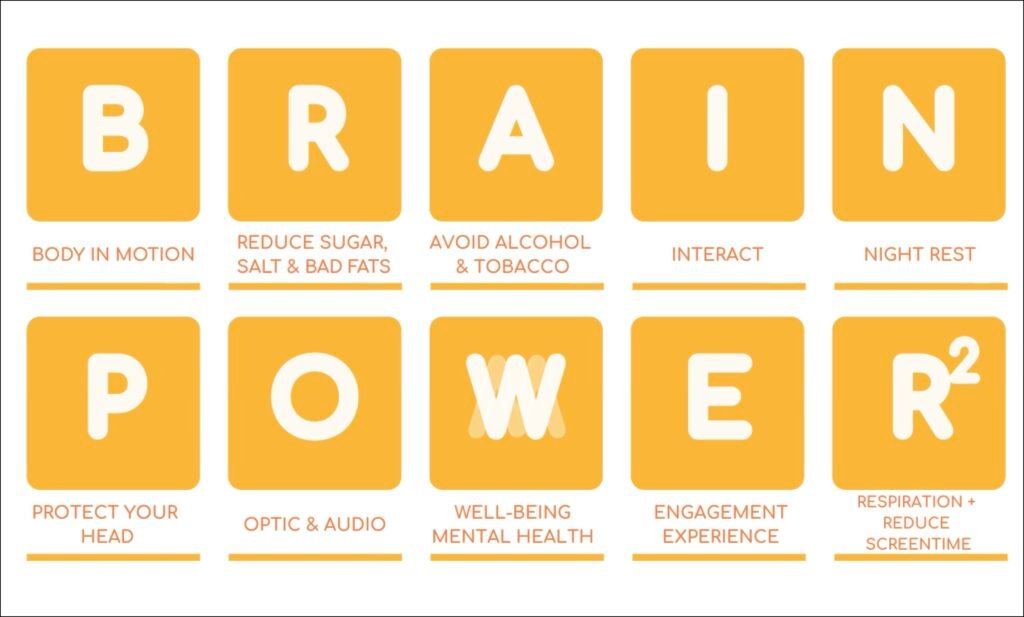
B – Body in Motion
We all know that physical activity is good for our health. But did you know that your brain benefits just as much, and sometimes even more, than the rest of your body?
- Immediate benefits: a natural brain boost
Moving your body not only triggers a ‘feel‑good chemical cocktail’ of dopamine, norepinephrine, and endorphins and increases blood flow, but it also boosts cognitive performance.4
- Long-term benefits: powerful protection for your brain
Regular physical activity doesn’t just improve how you feel and perform today, it protects your brain in the long run. Studies show that regular exercise is linked to structural changes in the brain, especially in memory-related regions such as the hippocampus.5 Furthermore, it is linked to significantly lower risk of dementia.2 Why? Because exercise increases blood flow and oxygen supply, stimulates the growth of new neural connections, supports neuroplasticity (the brain’s ability to adapt and learn) and reduces inflammation and vascular risk factors. Certain sports, like tennis, are especially beneficial: they combine cardiovascular effort, decision-making, coordination, strategy, and social interaction. This unique blend challenges both the body and the brain simultaneously.6
Remember: Movement is one of the most powerful ways to support your brain. You don’t need to run marathons to benefit. Every step counts, every minute helps, and your brain feels the effects both now and later. Try to apply this knowledge in your daily routine: park your car a bit farther away, choose a restroom that’s slightly farther, take the stairs instead of the escalator, or suggest to a colleague that you meet for a coffee and a short walk outside. You can also try going for a walk before your next important meeting, interview, or exam and observe how it affects you.
R – Reduce sugar, salt and bad fats
What we eat has a direct impact on our brain, not just our waistline or heart. Diets high in sugar, salt, and unhealthy fats can silently damage the brain’s blood vessels, increase inflammation, and raise the risk of conditions like stroke and dementia.2,3 The good news? Small changes make a big difference.
- Sugar
While our brain uses about up to 25% of the body’s glucose‑derived energy7, it actually suffers from the excessive sugar consumption common in modern diets. The World Health Organization (WHO) recommends limiting free sugars (sugars added to foods or drinks, and sugars naturally found in honey, syrups, and fruit juice) to a maximum of 50 grams per day.8, 9 Sounds a lot? It is roughly the amount found in one and a half can of soda. Too much sugar causes blood glucose to spike quickly and then drop sharply, leading to a well‑documented “sugar crash” with fatigue, reduced alertness, and lower concentration within an hour of consumption.10 Over time, repeated sugar spikes force the body to produce more insulin, eventually contributing to insulin resistance and type 2 diabetes. Since diabetes is one of the strongest metabolic risk factors for dementia,2 reducing sugar intake is a direct investment in long‑term brain health.
- Bad fats
Fat quality matters. While healthy fats (from nuts, seeds, olive oil, fish, and other minimally processed whole foods) are recommended, diets high in trans fats (found in baked and fried snacks, fast foods, and pre‑packaged products) and excess saturated fats (from fatty meats, butter, palm and coconut oil, cream and cheese) can raise LDL cholesterol, promote inflammation, and damage the blood vessels that supply the brain. To support long‑term brain and cardiovascular health, saturated fat should provide no more than 10% of daily calories, and trans fats should be avoided, ideally kept under 1% of energy intake. Replacing these with unsaturated fats, such as those in fish, avocado, nuts, sunflower, canola, soybean, and olive oils, and limiting highly processed foods help maintain a healthier fat balance.11
- Salt
Salt is another hidden threat. We need it but too much harms us. Most people consume far more salt than they realize. In adults, salt intake should be limited to less than 5 grams per day. Excess salt raises blood pressure, gradually damages the brain’s tiny arteries, which is a strong risk factor for both stroke and vascular dementia.11
Remember: what’s good for your heart is good for your brain. Ever heard about the MIND Diet? It stands for Mediterranean-DASH Intervention for Neurodegenerative Delay.12 It combines Mediterranean diet with the DASH diet, designed to deal with hypertension and heart health. Fruits, especially berries, are key. But so are green, leafy vegetables, nonstarchy vegetables, nuts, olive oil, whole grains, fish, beans and poultry. Choosing whole, minimally processed foods, cutting back on sugary drinks, cooking with healthier fats, and keeping salt in check are small habits that support long‑term brain health. And don’t forget the basics: regular health check‑ups matter. Indicators like cholesterol, blood pressure, weight, and diabetes risk are closely linked to brain health and cognitive decline.
A – Avoid alcohol, tobacco and CO
- Alcohol
“A glass of wine a day can’t hurt”, right? Unfortunately, this is an old myth. The WHO has clearly stated that no level of alcohol consumption is safe for your health including your brain.13 Even small amounts contribute to faster brain ageing and increase the risk of dementia, stroke, and other neurological conditions. If you choose to drink, it’s important to do so with the awareness that any amount carries some level of risk.
- Tobacco
Most people know that smoking harms the lungs and heart, but fewer realize how strongly it damages the brain. Cigarette smoke contains thousands of chemicals many of which are toxic for the brain. Over time, this leads to structural changes in your brain affecting how quickly and efficiently it processes information. 14, 15 These early structural changes can appear long before stroke or dementia symptoms. You may ask – what about vaping, electronic cigarettes and other e-liquid substances? Do they cause less damage? NO! A recent study discussed that the above-mentioned negative effects on our brain are also true for e-cigarettes.16 The good news is that stopping smoking quickly reduces these risks. Smoking cessation is one of the most effective brain‑health decisions you can make at any age.
Remember: Both alcohol and tobacco speed up brain ageing through similar mechanisms: they harm blood vessels, increase inflammation, and make the brain more vulnerable to long‑term disease. Reducing or avoiding these substances is a powerful way to protect your brain today and preserve it for the years ahead.
I – Interact
Can we “die of a lonely heart”? Or should we better say “of a lonely brain”? According to the WHO, loneliness is linked to around 100 deaths every hour, making it deadlier than obesity or physical inactivity.17 Loneliness physically changes the brain: it reduces mental stimulation, increases stress and inflammation, and is associated with smaller brain volumes in regions important for memory, all of which accelerate cognitive decline and increase dementia risk. It also affects daily habits by reducing physical activity, worsening diet, and increasing depression and sleep problems. The good news: social contacts you choose in your free time can counteract feelings of loneliness in other areas of life, and staying connected is one of the most powerful ways to protect your brain at any age. 2, 18-22
Remember: Invest in relationships as deliberately as you do in food, exercise, and sleep. Search for people with similar interests or hobbies for exchange, and meet up in environments that work for you. Reach out, meet up, and keep your brain connected.
N – Night rest
Sleep is not “switching off.” While your body rests, your brain becomes highly active, performing essential maintenance tasks: it processes and consolidates memories, clears metabolic waste, and restores the systems that support learning, attention and so on. For most adults, 7–9 hours of consistent, high‑quality sleep is ideal. Too little or poor‑quality sleep is linked to short-term problems with cognition, mood regulation, and some evidence points to increased risk of neurodegenerative diseases. While not all sleep problems are in our own power to address, there are habits that are detrimental for sleep, such as extended screentime in the evening.
Remember: Make sleep a non‑negotiable part of your brain‑care routine and prioritize habits that support deep, restorative rest. You can support better sleep by getting morning light exposure, keeping a regular sleep schedule, avoiding heavy meals close to bedtime, limiting caffeine and alcohol later in the day, and creating a sleep-friendly environment that is dark, cool, and quiet. Short naps earlier in the day are fine, but avoid long or late naps that disrupt nighttime rest. Treating sleep as daily brain care will help you stay sharper, happier, and healthier.23, 24
P – Protect your head
Our brain is a delicate organ, and although it is protected by the skull and cushioned by a clear, protective liquid called cerebrospinal fluid, head injuries are not uncommon. While head injuries occur most frequently in road traffic accidents, research indicates that certain sports, such as cycling, horse riding, boxing, and kitesurfing, are associated with a higher risk of severe traumatic brain injury. Additionally, one should not underestimate that repeated mild head injuries, like heading a ball in football, can also have serious consequences for brain health.2
Remember: if your favourite form of exercise involves contact sports or activities with a higher risk of falling, such as skiing, it is essential to protect your head. Wearing a helmet is a simple yet effective way to reduce the risk of head injuries.
O – Optic and Audio: Protect your senses
Worldwide, 1 in 5 people has hearing loss, due to age, exposure to harmful noise at work or in the environment, or due to untreated infections. Around 40% of those are under the age of 50.25 It is therefore highly recommended that you protect your hearing – reduce the sound levels on your earbuds and only go to loud concerts with some ear protection. Sensory impairments, such as hearing loss, can indirectly contribute to cognitive decline.
When vision or hearing is compromised, it becomes more difficult to process environmental stimuli. Although hearing aids can help, they may not always be fully comfortable and do not fully restore hearing abilities, especially in group settings. Difficulty in following conversations or engaging with others in noisy environments can increase psychosocial risks, such as loneliness, social isolation, and depression, all of which can, in turn, affect brain health.
Remember: General, protect yourself from harmful noise exposure, and if you already have hearing loss, use hearing aids. The same applies to your vision.
W/M – Well-Being and Mental health
When you think of clinical depression, you probably think of feeling down for long periods of time. But besides the impact on quality of life, depression, anxiety or other mental health disorders can also affect your ability to think, concentrate and make decisions. Research shows that depression increases the risk of dementia at all stages of adulthood.2
Remember: it’s important to care for your mental health, take preventive measures, and seek professional help if you experience low mood or lack of interest over prolonged periods of time.
E – Engage, Experience, Educate
Keep your brain active. Your brain is built to adapt at any age, thanks to neuroplasticity, the ability to form new connections and reorganise itself. Every time you challenge your brain, you strengthen this system and build cognitive reserve, a protective buffer against age‑related decline. While people with more education or cognitively demanding jobs tend to show a lower risk of dementia, everyone can benefit from mental engagement.
Remember: The key is variety: stay curious, keep challenging yourself, and make mental stimulation a joyful part of your daily life, your brain will thank you for it. Regular reading, learning a new skill or language, reading, playing strategy games, travelling, joining a discussion group, or simply exploring something unfamiliar all activate multiple brain regions and keep your thinking flexible
R – Respiration
Air pollution doesn’t just harm the lungs, it also affects the brain. Did you know that 99% of the world’s population currently lives in areas with air pollutant concentrations that exceed pollution limits.26 Research shows that long‑term exposure to polluted air is linked to poorer cognitive function and a higher risk of dementia.2 Tiny particles can enter the body through the lungs or nose and eventually reach the brain. Once there, they can trigger inflammation, damage neurons, and weaken the brain’s protective barriers. Air pollution also contributes to cardiovascular problems, which further increase dementia risk.2
Remember: While large‑scale solutions depend on policy changes, individuals can still reduce exposure, for example by choosing cleaner transport options, and being especially mindful during pregnancy and early childhood, when the brain is most vulnerable.
R – Reduce screen time
Digital technology is woven into our everyday lives from smartphones to social media to AI and while these tools bring convenience, connection, and endless learning opportunities, they also challenge a brain that evolved for a slower, face‑to‑face world. Excessive screen time can affect attention, sleep, mood, and even brain development, especially due to loss of focus, constant task‑switching, blue‑light exposure, and the addictive design of many apps. Yet technology is not inherently “good” or “bad”: in balanced doses it can stimulate cognitive skills, enhance learning, and help people stay socially connected or access mental‑health support.
Remember: The key is mindful use choosing tech that enriches the brain, not overwhelms it.
Do B.R.A.I.N.P.O.W.E.R. habits and other lifestyle changes still help if I already have a brain disease?
Absolutely! Healthy lifestyle habits offer support even after a brain disease has begun. They may help maintain function, improve wellbeing, and slow additional risk factors. However, these actions are supportive, not curative, and their effects vary by condition. It is important to consult your clinician before making major changes, especially regarding exercise, diet, or supplements.
All in all … Brain health is not predetermined. It’s built, strengthened, and protected through everyday actions. By integrating even a few B.R.A.I.N.P.O.W.E.R. habits into your routine, you can meaningfully reduce your risk of cognitive decline and support a healthier, sharper brain throughout life. Small steps truly add up. Start now, and your brain will benefit for years to come.
This content is not medical advice. Please consult your healthcare provider before making lifestyle changes.
© University of Luxembourg & Pauly Laure, 2025 – B.R.A.I.N.P.O.W.E.R² concept. If you wish to cite or reuse the B.R.A.I.N.P.O.W.E.R² acronym, please reference it as follows: Pauly, L. Leist, A. K. (2025). B.R.A.I.N.P.O.W.E.R² concept, University of Luxembourg.
For better readability of the text, the assistance of Microsoft Copilot, an AI language model based on the GPT-4 architecture, secured with UL enterprise data protection, has been used.
- Wang, J., Chen, C., Zhou, J. et al. Integrated healthy lifestyle even in late-life mitigates cognitive decline risk across varied genetic susceptibility. Nat Commun 16, 539 (2025). https://doi.org/10.1038/s41467-024-55763-0
- Livingston G, Huntley J, Liu KY, Costafreda SG, Selbæk G, Alladi S, et al. Dementia prevention, intervention, and care: 2024 report of the Lancet standing Commission. Vol. 404, The Lancet. Elsevier B.V.; 2024. p. 572–628.
- GBD 2021 Stroke Risk Factor Collaborators. Global, regional, and national burden of stroke and its risk factors, 1990–2021: a systematic analysis for the Global Burden of Disease Study 2021. The Lancet Neurology. 18 September 2024. doi: 10.1016/S1474-4422(24)00369-7.
- Mandolesi, L., Polverino, A., Montuori, S., Foti, F., Ferraioli, G., Sorrentino, P., & Sorrentino, G. (2018). Effects of Physical Exercise on Cognitive Functioning and Wellbeing: Biological and Psychological Benefits. Frontiers in psychology, 9, 509. https://doi.org/10.3389/fpsyg.2018.00509
- Raji CA, Meysami S, Hashemi S, Garg S, Akbari N, Gouda A, et al. Exercise-Related Physical Activity Relates to Brain Volumes in 10,125 Individuals. Journal of Alzheimer’s Disease. 2024 Jan 16;97(2):829–39.
- Schnohr P, O’Keefe JH, Holtermann A, Lavie CJ, Lange P, Jensen GB, Marott JL. Various leisure-time physical activities associated with widely divergent life expectancies: The Copenhagen city heart study. Mayo Clin Proc. 2018;93(12):1775–1785. doi: 10.1016/j.mayocp.2018.06.025. [DOI] [PubMed] [Google Scholar]
- Mergenthaler, P., Lindauer, U., Dienel, G. A., & Meisel, A. (2013). Sugar for the brain: the role of glucose in physiological and pathological brain function. Trends in neurosciences, 36(10), 587–597. https://doi.org/10.1016/j.tins.2013.07.001
- WHO Guideline: sugar intake for adults and children: https://www.who.int/publications/i/item/9789241549028 .
- WHO Factsheet about Sugar: https://cdn.who.int/media/docs/librariesprovider2/euro-health-topics/obesity/sugars-factsheet.pdf
- Mantantzis, K., Schlaghecken, F., Sünram-Lea, S. I., & Maylor, E. A. (2019). Sugar rush or sugar crash? A meta-analysis of carbohydrate effects on mood. Neuroscience & Biobehavioral Reviews, 101, 45–67. https://doi.org/10.1016/j.neubiorev.2019.03.016
- https://www.who.int/news-room/fact-sheets/detail/healthy-diet
- Morris, M. C., Tangney, C. C., Wang, Y., Sacks, F. M., Barnes, L. L., Bennett, D. A., & Aggarwal, N. T. (2015). MIND diet slows cognitive decline with aging. Alzheimer’s & dementia : the journal of the Alzheimer’s Association, 11(9), 1015–1022. https://doi.org/10.1016/j.jalz.2015.04.011
- https://www.who.int/news-room/fact-sheets/detail/alcoholf
- McClernon, F. J., Froeliger, B., Rose, J. E., Kozink, R. V., Addicott, M. A., Sweitzer, M. M., Westman, E. C., & Van Wert, D. M. (2015). The effects of nicotine and non-nicotine smoking factors on working memory and associated brain function. Addiction Biology, 21(4), 954–961. https://doi.org/10.1111/adb.12253
- Swan, G. E., & Lessov-Schlaggar, C. N. (2007). The effects of tobacco smoke and nicotine on cognition and the brain. Neuropsychology Review, 17(3), 259–273. https://doi.org/10.1007/s11065-007-9035-9
- López-Ojeda, W., & Hurley, R. A. (2024). Vaping and the brain: effects of electronic cigarettes and e-liquid substances. The Journal of Neuropsychiatry and Clinical Neurosciences, 36(1), A5-5.
- https://www.who.int/news/item/30-06-2025-social-connection-linked-to-improved-heath-and-reduced-risk-of-early-death
- Park, C., Majeed, A., Gill, H., Tamura, J., Ho, R. C., Mansur, R. B., Nasri, F., Lee, Y., Rosenblat, J. D., Wong, E., & McIntyre, R. S. (2020). The Effect of Loneliness on Distinct Health Outcomes: A Comprehensive Review and Meta-Analysis. Psychiatry Research, 294, 113514. https://doi.org/10.1016/j.psychres.2020.113514
- Hawkley, L. C. (2022). Loneliness and health. Nature Reviews Disease Primers, 8(1), 22. https://doi.org/10.1038/s41572-022-00355-9
- Lam, J. A., Murray, E. R., Yu, K. E., Ramsey, M., Nguyen, T. T., Mishra, J., Martis, B., Thomas, M. L., & Lee, E. E. (2021). Neurobiology of loneliness: a systematic review. Neuropsychopharmacology, 46(11), 1873–1887. https://doi.org/10.1038/s41386-021-01058-7
- Doane, L. D., & Adam, E. K. (2009). Loneliness and cortisol: Momentary, day-to-day, and trait associations. Psychoneuroendocrinology, 35(3), 430–441. https://doi.org/10.1016/j.psyneuen.2009.08.005
- Smith, K. J., Gavey, S., RIddell, N. E., Kontari, P., & Victor, C. (2020). The association between loneliness, social isolation and inflammation: A systematic review and meta-analysis. Neuroscience & Biobehavioral Reviews, 112, 519–541. https://doi.org/10.1016/j.neubiorev.2020.02.002
- Watson, N. F., Badr, M. S., Belenky, G., Bliwise, D. L., Buxton, O. M., Buysse, D., Dinges, D. F., Gangwisch, J., Grandner, M. A., Kushida, C., Malhotra, R. K., Martin, J. L., Patel, S. R., Quan, S., & Tasali, E. (2015). Recommended amount of sleep for a healthy adult: A joint consensus statement of the American Academy of Sleep Medicine and Sleep Research Society. SLEEP, 38(6), 843–844. https://doi.org/10.5665/sleep.4716
- Baranwal, N., Yu, P. K., & Siegel, N. S. (2023). Sleep physiology, pathophysiology, and sleep hygiene. Progress in Cardiovascular Diseases, 77, 59–69. https://doi.org/10.1016/j.pcad.2023.02.00
- Haile LM, Kamenov K, Briant PS, Orji AU, Steinmetz JD, Abdoli A, et al. Hearing loss prevalence and years lived with disability, 1990-2019: Findings from the Global Burden of Disease Study 2019. The Lancet. 2021 Mar 13;397(10278):996–1009.
- World Health Organization. https://www.who.int/news-room/fact-sheets/detail/ambient-(outdoor)-air-quality-and-health. Wu, J., Grande, G., Stafoggia, M., Ljungman, P., Laukka, E. J., Eneroth, K., Bellander, T., & Rizzuto, D. (2022). Air pollution as a risk factor for Cognitive Impairment no Dementia (CIND) and its progression to dementia: A longitudinal study. Environment International, 160(2022), 107067. https://doi.org/10.1016/j.envint.2021.107067.